
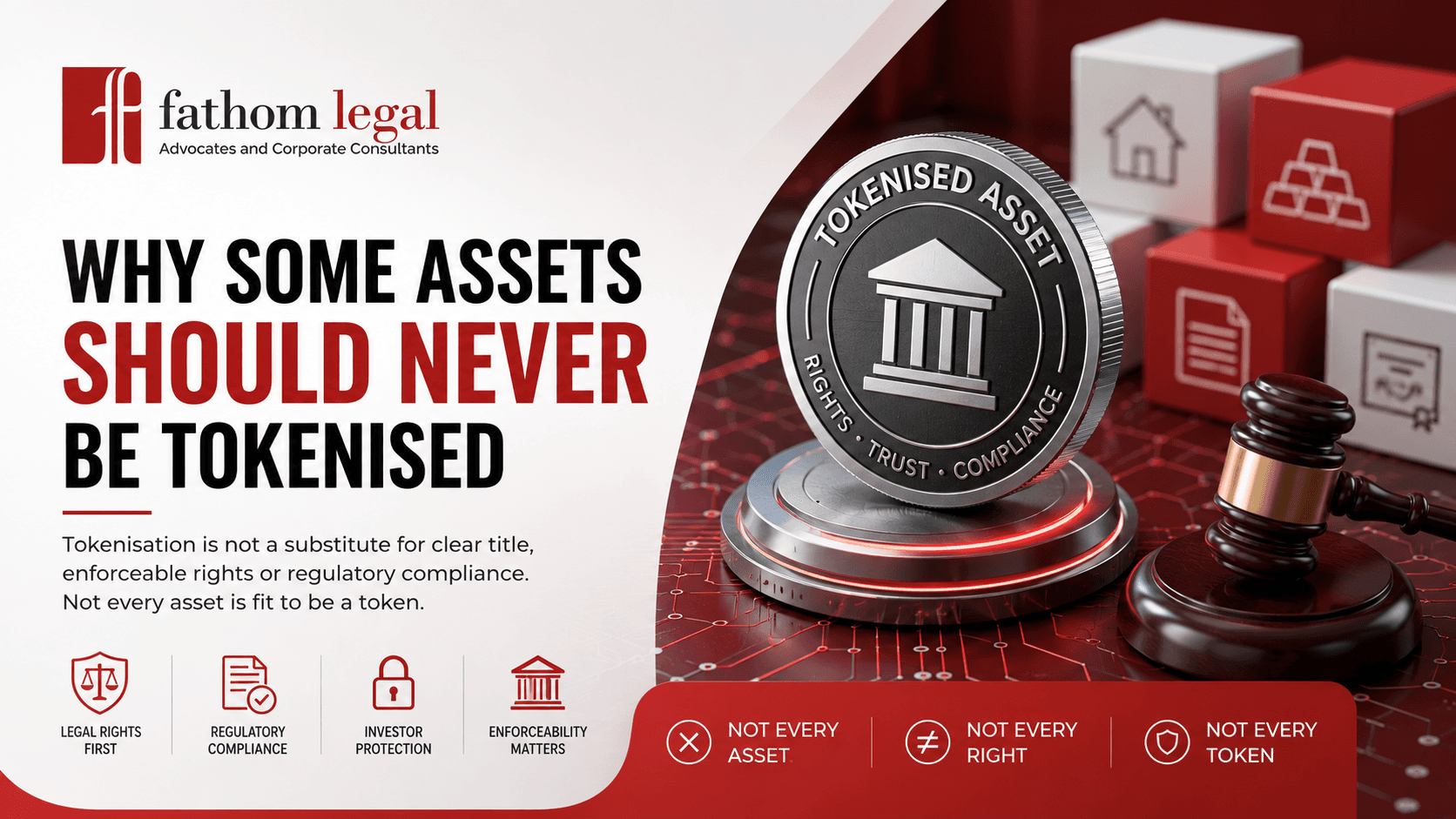
Every RWA platform pitch deck contains some version of the same claim: tokenisation converts illiquid assets into liquid, fractionalised, globally tradeable instruments. As India's Asset Tokenisation/RWA framework moves from consultation to statute, that claim is going to be tested against actual legal structures, actual investor grievances, and actual enforcement action not against a slide.
For counsel advising issuers, and for fintech teams building the rails, the operative question isn't "can this asset be tokenised" almost anything can be represented as a token. It's whether the resulting instrument creates an enforceable, transferable, regulator-defensible right, or whether it creates a technically sophisticated wrapper around a legal defect. This piece works through the structuring questions that should be resolved before term sheets go out, not after a token is already trading.
Tokenisation as a Legal Question, Not a Technical One
Tokenisation is the representation of rights in an asset as a digital token on a distributed ledger. The critical point for structuring purposes: a token has no inherent legal status. It is data. It acquires legal effect only through the instrument that sits behind it a trust deed, an SPV constitutional document, a debenture, a unit of a fund. Section 3 of the Indian Contract Act, 1872 does not recognise a wallet address as a contracting party; the contracting party is whoever the underlying documentation identifies, and the token is, at best, evidence of a claim against that party.
This is the same conceptual move India has already made with dematerialisation a demat account entry doesn't create the shareholder's rights, the Companies Act and the issuer's register do; the depository system (NSDL/CDSL, under the Depositories Act, 1996) merely records and transfers them. Tokenisation is attempting the same abstraction without an equivalent statutory depository framework, IFSCA's more recent tokenisation guidance for GIFT City notwithstanding. Counsel should treat every tokenisation mandate as a securities/property structuring exercise first, and a smart contract deployment second. Fintech teams should resist the instinct to let the technical architecture define the legal one the SPV, trust, or fund structure should be settled, and its transfer mechanics validated against the relevant transfer-of-title law, before a single line of the token contract is written.
Structural Mechanics and Where They Break
The standard stack: (1) an SPV, trust, or AIF-style vehicle takes legal title to the underlying asset; (2) the vehicle issues tokens representing beneficial interests, debt, or a purely contractual entitlement against itself; (3) a smart contract governs issuance, whitelisting, and transfer restrictions; (4) an off-chain servicer continues to manage the physical or financial asset and pushes distributions on-chain or off.
Each handoff between the legal layer and the technical layer is a point where representations in the offer document can diverge from what the smart contract actually enforces. Three recurring gaps are worth flagging to clients directly:
Transfer restrictions coded off-chain assumptions. If the offer document promises SEBI-style investor eligibility gating (accredited investor thresholds, lock-in periods) but the smart contract's whitelist logic isn't kept current with KYC status, the platform is misrepresenting enforceability, not just running an operational gap.
The servicer is rarely a party to the smart contract. Rent collection, loan servicing, or dividend declaration typically happens through a conventional legal relationship with the SPV the token doesn't automate this, and platforms that imply otherwise are overstating what the architecture does.
Custody of the underlying asset and custody of the token are separate questions. A well-drafted custody arrangement for the physical/financial asset does not, by itself, resolve who has legal custody obligations over the token or the private keys controlling it this needs its own contractual treatment, and its own liability allocation if the platform or a wallet provider is compromised.
What Makes an Underlying Asset Credible for Tokenisation
From a diligence standpoint, an asset clears the bar for tokenisation only if four things can each be independently evidenced, not merely represented by the promoter:
Clean, transferable legal title, vested in the SPV/trust in a form that doesn't require third-party consents the token structure has no mechanism to obtain (mortgagee consent, ROFR waivers, statutory approvals).
A valuation methodology that doesn't originate with the issuer third-party appraisal, audited financials, or an observable market price, disclosed in the offer document with the same rigour SEBI would expect of an AIF PPM.
Contractually enforceable cash flows, where the right to income is a legal claim under the trust deed/SPV documents, not a projection dependent on future performance the issuer controls.
A servicer with independent legal accountability and identifiable assets not an offshore shell with no recourse if servicing obligations are breached.
For fintech platforms building tokenisation infrastructure, this diligence sits upstream of the product it's an onboarding gate for issuers, not a disclosure to be made after the token is live. Platforms that treat asset vetting as the issuer's problem alone are exposed themselves, particularly if positioned as an intermediary under India's evolving VDA/VASP framework.
The Investor's Actual Legal Position
This is the section that should get the most drafting attention, because "fractional ownership" is doing a lot of unearned work in most marketing copy. The token can represent, at minimum, four materially different legal positions:
Direct co-ownership recorded against title (rare, and generally impractical at token-scale fractionalisation under the Transfer of Property Act, 1882 and applicable registration law).
A beneficial interest under a trust governed by the Indian Trusts Act, 1882, with the SPV/trustee holding legal title.
A debt or preference instrument issued by the SPV a contractual creditor claim, not a proprietary interest in the asset.
A purely contractual right against the issuing platform, with no proprietary nexus to the underlying asset at all functionally closer to a promissory note than an ownership instrument.
The insolvency-remoteness question is where this stops being academic. If the SPV or the platform becomes insolvent, does the investor's claim rank as a proprietary interest that survives the insolvency estate, or as an unsecured claim in the liquidation waterfall? This should be answered explicitly in the offer document, with the applicable insolvency treatment under the IBC set out, not left to be inferred from token nomenclature. Counsel drafting these instruments should be doing the same insolvency-remoteness analysis that securitisation and REIT/InvIT structuring already requires tokenisation doesn't get a lighter standard just because the wrapper is newer.
Is Tokenisation Solving an Actual Market Failure
Worth separating two categories before a mandate is accepted. Some illiquidity is structural and addressable commercial real estate, infrastructure debt, private credit pools with stable, verifiable cash flows are reasonable candidates, and India already has a fractional-ownership precedent in REITs and InvITs regulated under SEBI's respective regulations, which tokenisation could in principle extend to smaller ticket sizes with lower overhead than a listed trust structure.
Other illiquidity exists because the instrument is deliberately restricted to sophisticated investors — AIF units, certain structured credit, instruments carrying investor-protection conditions under SEBI regulations precisely because retail distribution was assessed as inappropriate. Tokenising these to reach retail-scale investors doesn't solve a liquidity problem; it circumvents the regulatory judgment that created the restriction, and counsel should flag this distinction to fintech clients as a regulatory-arbitrage risk rather than a product opportunity, however the platform frames it commercially.
Whether the Liquidity Being Sold Is Real
A token is transferable in principle from the moment it's minted; it is liquid only when a functioning, permitted secondary market exists for it. This is the gap that produces the most investor grievances in practice: the token trades nowhere, because the venue that was meant to list it lacks regulatory clarity on whether the instrument is a security, a VDA, or something else requiring its own registration, and licensed exchanges won't touch an unresolved classification. Built-in transfer restrictions necessary for KYC/AML and investor-eligibility compliance often recreate a meaningful share of the illiquidity the structure was meant to cure.
For due diligence purposes, before advising an issuer to proceed, counsel should require the platform to name the actual trading venue, its regulatory basis for listing the instrument, and realistic volume expectations, as a condition precedent to issuance not as a forward-looking roadmap item in the offer document.
Compliance Across the Asset's Life Cycle, Not Just at Issuance
Issuance-stage compliance KYC at onboarding, an offering memorandum, a securities law opinion is the tractable part. The harder obligation, and the one most tokenisation structures under-resource, is sustaining compliance across the life of the instrument:
Secondary transfers require the same AML/KYC screening as primary issuance, on every transfer, which is difficult to guarantee on-chain without a permissioned ledger or a robust whitelist-and-freeze mechanism built into the smart contract and PMLA/FIU-IND reporting obligations don't relax because a transfer happened peer-to-peer rather than through the platform.
Cross-border holders trigger FEMA, withholding tax, and sanctions-screening analysis on every transfer, not only the first a structure that clears FEMA at issuance but has no mechanism to re-screen on secondary transfer is not actually compliant, it's compliant once.
Regulatory classification is not fixed at issuance. An instrument treated as a straightforward asset-backed token today can be recharacterised as a security or a VDA requiring registration as the regulatory framework around the RWA Bill and IFSCA's tokenisation rules matures with consequences that can apply retroactively to the issuer and, potentially, to the platform.
Material changes to the underlying asset a property sale, SPV restructuring, servicer replacement require updated disclosure and, in some structures, investor consent mechanisms that most token contracts have no native way to execute.
A compliance programme that is fully resourced at issuance and unresourced thereafter is not a compliance programme; it's a launch checklist. This is the single most common structural gap counsel should be testing for.
Assets That Should Not Be Tokenised
Bringing the above together, the following categories fail the threshold regardless of how well-built the technical layer is, and should be flagged as such in any advisory mandate:
Assets with disputed, informal, or unregistrable title, where the token records a right the underlying law doesn't clearly recognise.
Assets whose valuation depends entirely on the issuer's own projections, with no independently verifiable benchmark.
Instruments that regulators restrict to sophisticated or accredited investors for investor-protection reasons tokenising for retail distribution should be treated as a compliance red flag, not a growth strategy.
Assets with no servicer bearing independent legal and financial accountability.
Structures where "liquidity" is the core value proposition but no counsel can identify the venue, the regulatory basis for trading, or realistic demand.
Practical Takeaway
For law firms advising issuers, the mandate should include insolvency-remoteness analysis, a clear statement of the investor's proprietary versus contractual position, and a life-cycle compliance plan not just an issuance opinion. For fintech platforms building tokenisation infrastructure, the technical build should follow, not precede, resolution of the underlying legal structure and the regulatory classification of the instrument. Tokenisation changes how a right is recorded and transferred; it does not upgrade the quality of the right itself. Structured on a sound asset, it's a genuine efficiency gain. Structured on a defective one, it is the same defect, distributed faster, to a wider and less sophisticated investor base, with a compliance surface that most platforms are currently under-building for.
At Fathom Legal Advocates & Corporate Consultants, we work with fintech companies, Web3 businesses, financial institutions and investors to navigate this evolving landscape. From product structuring, regulatory analysis and legal opinions to transaction documentation, compliance frameworks and cross-border advisory, our approach is to ensure that innovation is supported by legally robust foundations. In an ecosystem where technology evolves faster than regulation, the right legal architecture is not merely a safeguard it is a competitive advantage.
This article is intended for general informational purposes and does not constitute legal advice. For structuring or compliance guidance on a specific tokenisation mandate, please consult Fathom Legal Advocates & Corporate Consultants.