
Introduction: How the Compliance Landscape Has Changed:
India's Digital Personal Data Protection Act, 2023 (DPDPA) marks a transformative shift in the country's approach to privacy and data governance. For over a decade, the regulation of personal data was largely governed by the limited framework of the SPDI Rules, 2011, issued under the Information Technology Act, 2000. The enactment of the DPDPA has fundamentally changed this landscape by introducing India's first comprehensive, principle based data protection law. The Act establishes a structured legal framework that imposes enforceable obligations on entities that determine the purpose and means of processing personal data, referred to as Data Fiduciaries, while simultaneously granting statutory rights to individuals, known as Data Principals, whose personal data is processed. In doing so, the legislation seeks to balance the legitimate use of personal data with the protection of individual privacy in an increasingly digital economy.
As the Ministry of Electronics and Information Technology (MeitY) moves towards the implementation and enforcement of the DPDPA framework and the DPDP Rules, 2025, organisations across sectors are expected to face heightened regulatory scrutiny. Compliance will no longer be assessed solely on the basis of policies and documentation businesses will be required to demonstrate that privacy obligations are effectively embedded within their operational processes, governance structures, and technology systems.
What Does a DPDPA Readiness Assessment Actually Involve?
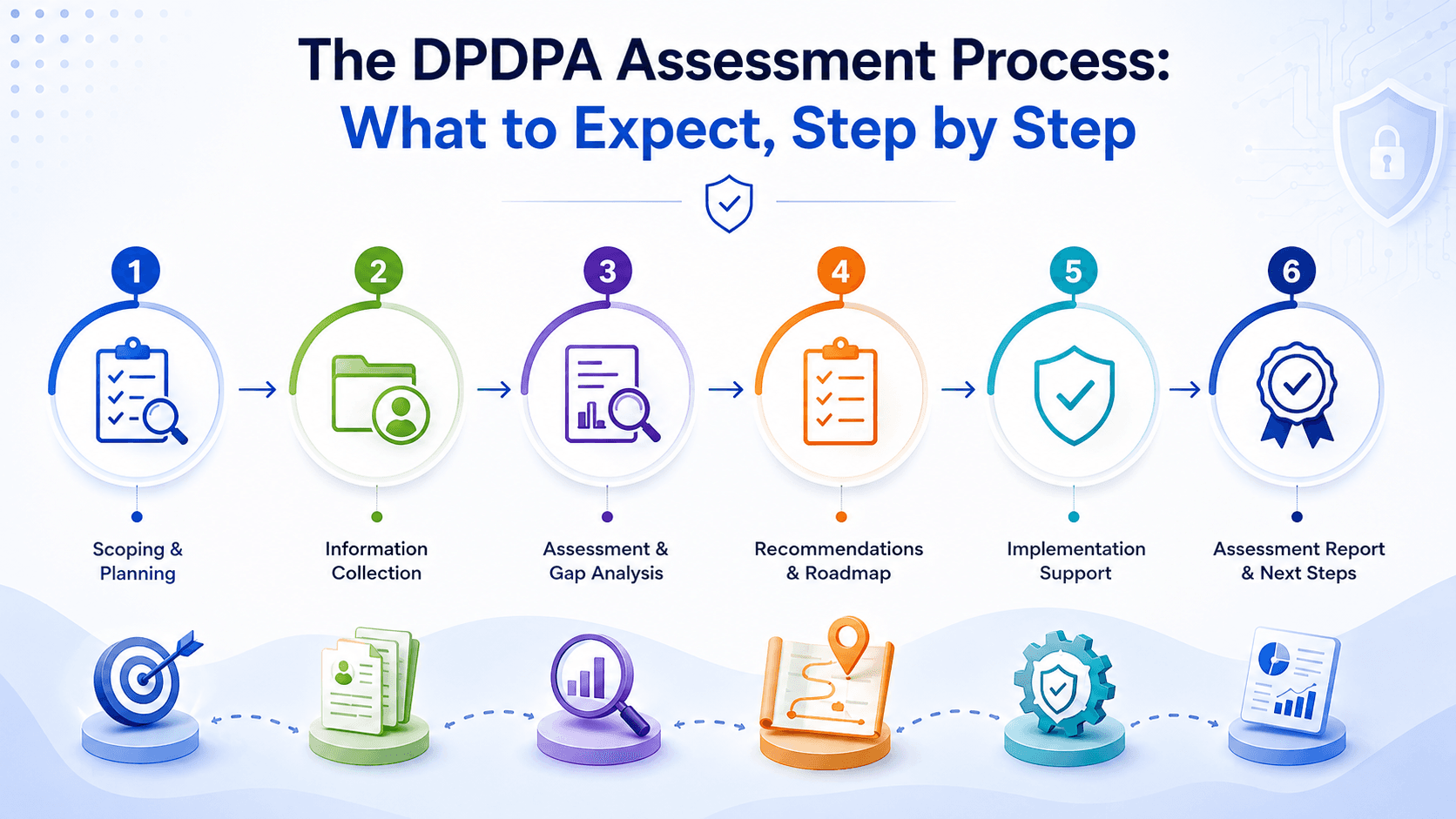
A DPDPA readiness assessment becomes a critical first step toward compliance. Rather than merely reviewing policies and legal documentation, it provides a practical evaluation of how an organisation actually collects, uses, stores, shares and protects personal data in light of the DPDPA, 2023 and the DPDP Rules, 2025. The objective is to identify compliance gaps, assess associated risks and establish a clear roadmap for remediation. Importantly, the assessment bridges the often overlooked gap between documented compliance and operational reality. An organisation may have well drafted privacy notices, consent mechanisms and contractual safeguards, yet still fall short if its day to day practices do not align with those commitments. As regulatory expectations increasingly focus on demonstrable compliance, organisations must ensure that privacy obligations are embedded across their people, processes and technology.
To achieve this, a readiness assessment examines the organisation's data lifecycle, governance framework, vendor ecosystem, security controls and mechanisms for responding to Data Principal rights. Once an organisation understands what personal data it holds, the next step is to examine how that data is collected, processed and governed. This begins with data mapping and flow analysis, which identify the categories of personal data collected, the purposes for which it is processed, the systems in which it resides and the third parties with whom it is shared. The assessment then evaluates privacy notices and consent mechanisms against the requirements of Section 6 of the DPDPA and the DPDP Rules, 2025. Organisations must ensure that consent is free, specific, informed, and capable of being withdrawn with ease. Equally important is the organisation's internal governance framework. The assessment reviews data retention practices, employee awareness programmes, breach response procedures and overall accountability mechanisms as it is a mandatory obligation under section 8 (6),DPDPA, 2023 a Data Fiduciary must notify the Data Protection Board and affected Data Principals of a personal data breach in the prescribed manner and the DPDP rules 2025, rule 7 set demanding timelines and content requirements for that notification. However, compliance does not end within the organisation's boundaries. Since personal data routinely flows through vendors, service providers and cloud platforms, the next stage of the assessment focuses on managing third-party risks and ensuring that external data processing arrangements meet the standards prescribed under the DPDPA framework.
After assessing internal governance, attention shifts to the external partners and systems that process personal data on the organisation's behalf. Under the DPDPA, outsourcing data processing does not outsource accountability. Data Fiduciaries remain responsible for ensuring that vendors, cloud providers and other Data Processors handle personal data in accordance with contractual and regulatory requirements. A readiness assessment therefore examines third party agreements, data-sharing arrangements and vendor oversight mechanisms to identify gaps that could expose the organisation to significant compliance risks. Alongside these reviews, the assessment evaluates the organisation's technical and organisational security measures. Section 8(5) of the DPDPA requires Data Fiduciaries to implement reasonable safeguards to protect personal data, making it essential to assess access controls, encryption practices, monitoring systems and breach response capabilities. Equally important is the organisation's ability to identify and report a personal data breach within the timelines prescribed under the DPDP Rules, 2025.Thus, governance, vendor management and security controls form the operational backbone of compliance, the DPDPA places individuals at the centre of the regulatory framework.Organisations must therefore be prepared to effectively recognise, process and respond to the rights granted to Data Principals under the Act. Together, these measures help establish a robust compliance foundation. Yet the DPDPA's ultimate objective is to empower Data Principals, requiring organisations to demonstrate that they can effectively honour statutory rights throughout the data lifecycle.
A privacy programme is only as effective as its ability to uphold the rights granted to Data Principals under the Digital Personal Data Protection Act, 2023. Accordingly, a readiness assessment also evaluates whether the organisation can effectively respond to requests for access to personal data, correction, erasure, grievance redressal and other statutory rights under Sections 11 to 14 of the DPDPA, read with the Digital Personal Data Protection Rules, 2025. The key question is straightforward, can the organisation accurately identify, retrieve, update or delete an individual's personal data across all systems and third-party platforms when required? For many organisations, this remains one of the most significant operational challenges.
Gap Analysis and Remediation Planning:
Once these capabilities are assessed, the findings are consolidated into a gap analysis that prioritises risks based on their legal, operational, financial and reputational impact. High-priority issues, such as non compliant consent mechanisms under Section 6 of the DPDPA, inadequate breach response processes under Section 8 and Rule 7 of the DPDP Rules or an inability to fulfil Data Principal requests require immediate remediation, while lower-risk findings help strengthen governance maturity over time. The assessment culminates in a practical remediation roadmap that translates the requirements of the DPDPA and DPDP Rules into actionable business objectives. By prioritising corrective measures, allocating resources and establishing clear accountability, organisations can move beyond identifying compliance gaps and begin building a sustainable privacy governance framework capable of adapting to evolving regulatory expectations. Ultimately, a readiness assessment is not merely a compliance exercise, it is a strategic blueprint that enables organisations to transition from reactive compliance to proactive privacy governance under India's emerging data protection laws.
Conclusion: From Readiness to Compliance:
The era of data protection compliance in India is no longer a future consideration, it is a present business imperative. With the DPDPA, 2023 and the DPDP Rules, 2025 establishing a comprehensive regulatory framework and with the Ministry of Electronics and Information Technology (MeitY) driving implementation and oversight of India’s data protection regime, organisations are expected to demonstrate not only that they understand their obligations but that they have operationalised them across their people, processes and technology systems.
As this article has explored, compliance extends far beyond drafting privacy policies or updating contractual clauses. It requires a clear understanding of data flows, effective consent management, robust governance structures, third-party risk oversight, security safeguards and the ability to honour Data Principal rights in practice. A DPDPA readiness assessment provides the foundation for this journey by identifying compliance gaps, prioritising risks and creating a practical roadmap for remediation.
At Fathom Legal, we work closely with organisations to transform regulatory requirements into practical compliance programmes. Our team assists businesses in conducting comprehensive DPDPA readiness assessments, mapping data ecosystems, reviewing consent and governance frameworks, evaluating vendor and security risks and developing tailored remediation roadmaps aligned with business objectives. The goal is not merely to achieve compliance, but to build a defensible and scalable privacy framework that can evolve alongside the organisation and the law. As MeitY continues to operationalise India’s data protection framework and regulatory expectations become clearer, organisations that invest in readiness today will be far better equipped to respond to tomorrow’s compliance challenges. The question is no longer whether organisations should prepare for the DPDPA, it is whether they will be ready when regulators, investors, customers and business partners begin asking for proof. A readiness assessment is often the first and most important step towards answering that question with confidence. At Fathom Legal, we help organisations move beyond compliance checklists and build privacy frameworks that inspire confidence, withstand scrutiny and support long term growth.