
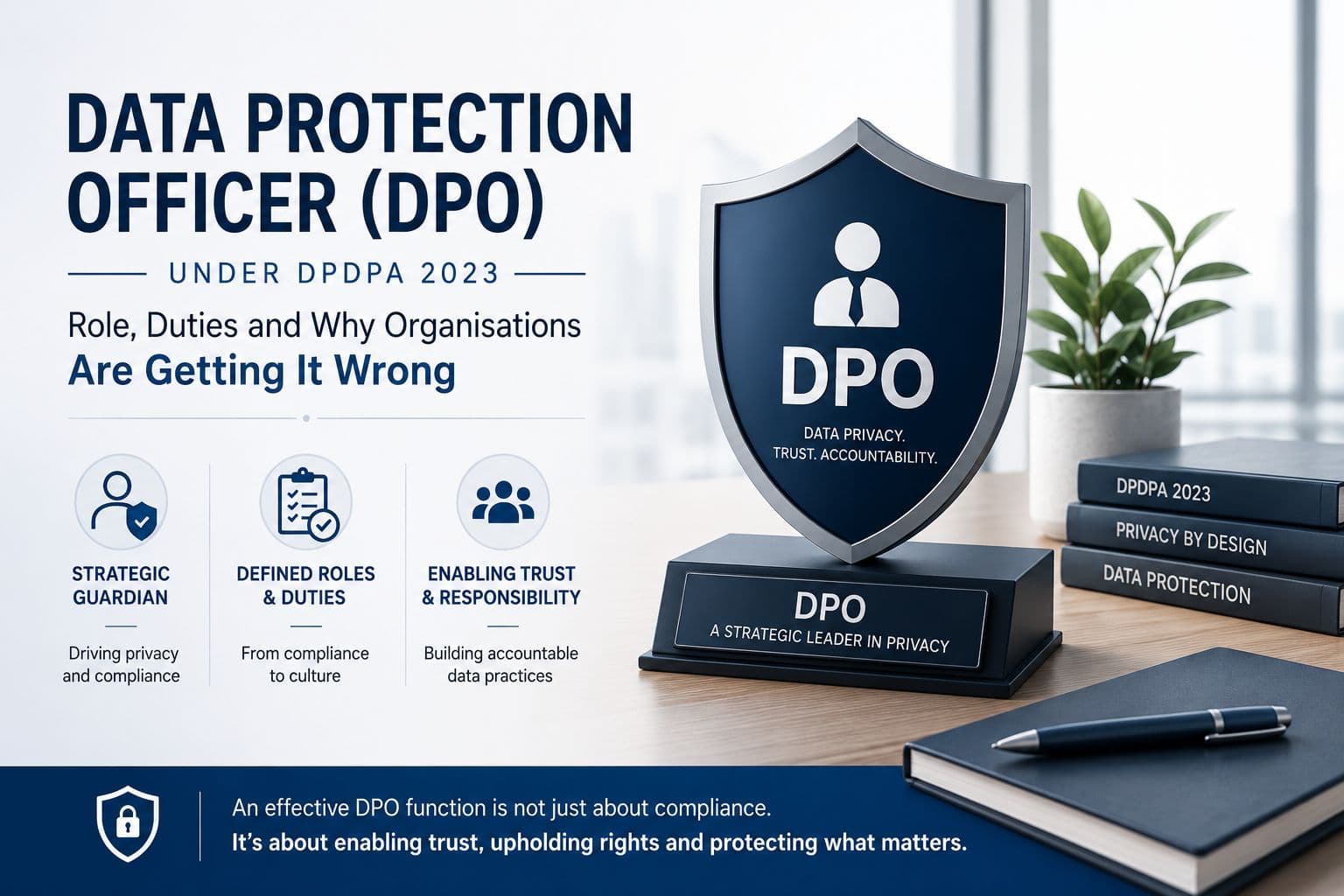
Introduction: As organisations prepare for compliance with the Digital Personal Data Protection Act, 2023 (DPDPA) and the Digital Personal Data Protection Rules, 2025, much of the focus has been on consent management, privacy notices, and data security measures. However, one of the most critical and often misunderstood elements of the framework is the role of the Data Protection Officer (DPO). Many businesses continue to view the DPO as a mere compliance designation. In reality, the DPO is a key accountability mechanism designed to ensure that personal data is processed responsibly, that Data Principal rights are respected and that organisations can demonstrate compliance through effective governance. Understanding the true purpose of this role is essential for any organisation seeking to build a sustainable data protection framework under the DPDPA. To understand why the DPO occupies such a central position within India's data protection regime, it is important to first examine how the law itself conceptualises the role.
The Legislative Foundation of the DPO Under DPDPA
Unlike several international privacy laws that prescribe detailed requirements regarding the qualifications, independence and reporting structure of a Data Protection Officer, the DPDPA adopts a more principle based approach. Rather than focusing on form, the legislation focuses on accountability and outcomes. This obligation emerges primarily from Section 10 of the DPDPA, which imposes additional responsibilities upon entities classified as Significant Data Fiduciaries (SDF). Under Section 10(2)(a), every Significant Data Fiduciary is required to appoint a Data Protection Officer who shall represent the organisation under the provisions of the Act. The law further mandates that such officers must be based in India and serve as the primary point of contact for grievance redressal relating to the processing of personal data.
At first glance, this may appear to be a procedural requirement. However, a closer reading reveals a much broader legislative intent. The lawmakers recognised that compliance cannot be achieved solely through technical controls, contractual clauses or legal documentation. Data protection ultimately requires ownership. It requires an identifiable individual who can oversee governance mechanisms, coordinate responses to Data Principal requests, facilitate engagement with regulators and ensure that accountability is embedded into organisational decision making.In many ways, therefore, the DPO becomes the human embodiment of an organisation's commitment to privacy. But this naturally raises another question, which organisations are actually required to appoint one?
Who Must Appoint a Data Protection Officer?
A common misconception under the DPDPA is that every Data Fiduciary must appoint a DPO. In reality, the obligation applies only to entities designated as Significant Data Fiduciaries under Section 10(1) of the Act. While determining whether an organisation qualifies as an SDF, the Central Government may consider factors such as the volume and sensitivity of personal data processed, risks to the rights of Data Principals, potential impacts on national interests and public order. This reflects the DPDPA's risk based approach, under which organisations engaged in higher risk processing activities are subject to enhanced accountability obligations.The Digital Personal Data Protection Rules, 2025 further reinforce this framework by requiring designated entities to maintain effective grievance redressal and compliance mechanisms. Accordingly, organisations that are likely to be classified as Significant Data Fiduciaries should begin strengthening their governance structures. And once organisations begin examining what compliance truly entails, they quickly realise that the DPO's responsibilities extend far beyond what many initially assume.
Understanding the role and responsibility of the DPO
The greatest mistake organisations make is reducing the DPO's role to grievance management or privacy notice administration. In reality, the position sits at the crossroads of law, technology, governance, risk management and business operations. A properly empowered DPO functions as a strategic advisor and accountability officer. The role involves monitoring compliance obligations, assessing privacy risks, reviewing governance frameworks, coordinating incident response efforts, advising leadership on regulatory developments and ensuring that personal data processing activities remain aligned with the requirements of the DPDPA.
However, these responsibilities only scratch the surface. The DPO is expected to maintain visibility over the entire lifecycle of personal data within the organisation, from collection and use to storage, sharing, retention, and deletion. This requires a deep understanding of how personal data flows across departments, systems, vendors and business processes. Without such visibility, it becomes nearly impossible to identify compliance gaps or assess whether processing activities remain consistent with the purposes for which personal data was originally collected.
The DPO plays a critical role in ensuring compliance with the obligations imposed upon Data Fiduciaries under Section 8 of the DPDPA. This includes overseeing the implementation of reasonable security safeguards, ensuring that personal data is processed only for lawful purposes, monitoring adherence to retention and erasure requirements and verifying that organisational practices remain aligned with the principles of accountability and transparency embedded within the Act. As part of this responsibility, the DPO is also expected to play a key role in personal data breach preparedness and response. This includes coordinating incident response efforts, facilitating breach assessments and ensuring compliance with breach notification obligations prescribed under the DPDPA and the Digital Personal Data Protection Rules, 2025.
Another key responsibility involves advising the organisation on privacy by design and governance measures. While the DPDPA does not expressly use the term "privacy by design" in the same manner as certain international frameworks, the spirit of the legislation clearly encourages organisations to integrate privacy considerations into business processes from the outset rather than attempting to address compliance concerns after products, services or systems have already been deployed. The DPO therefore becomes an important participant in discussions relating to new technologies, digital platforms, customer facing applications, artificial intelligence tools and data driven business initiatives.
The DPO's role also extends to vendor and third party risk management. Modern organisations rarely process personal data in isolation. Cloud service providers, payroll vendors, marketing agencies, analytics platforms, customer relationship management systems and outsourced service providers often form part of the broader data ecosystem. The DPO must therefore work closely with procurement, legal and operational teams to assess whether appropriate contractual safeguards, due diligence measures and oversight mechanisms are in place when personal data is shared with third parties.
The DPO also serves as an internal advisor during strategic decision making. Whether the organisation is launching a new product, entering a new market, adopting emerging technologies or restructuring its operations, the DPO should be involved in assessing potential privacy implications. This proactive involvement helps organisations identify risks before they materialise into regulatory violations or reputational damage. Equally important is the DPO's responsibility to foster a culture of privacy awareness within the organisation. Compliance cannot be achieved through policies alone. Employees who collect, access, process or manage personal data must understand their obligations under the law.
Furthermore, the DPO acts as the central point of coordination between the organisation and external stakeholders. This includes interactions with Data Principals, regulatory authorities, auditors, consultants and wherever necessary. The ability to communicate effectively with both technical and non technical stakeholders is therefore an essential aspect of the role. Yet, despite the breadth and strategic importance of these responsibilities, many organisations continue to misunderstand what the role actually requires. The result is that businesses often appoint a DPO in name, while failing to establish the governance structure necessary for the role to function effectively. This disconnect between designation and empowerment has emerged as one of the most significant compliance challenges under the DPDPA.
Why Organisations Are Getting It Wrong:
As awareness of the DPDPA grows, organisations are increasingly rushing to identify individuals who can be designated as DPOs. Unfortunately, many are focusing on the appointment itself rather than the purpose behind it. The most common mistake is treating the role as a box-ticking exercise. An employee is designated as DPO, but receives little authority, limited resources, minimal visibility into organisational processes and no meaningful access to senior management. In such circumstances, the title exists, but the function does not.
Another frequent error is assuming that privacy compliance is exclusively a technology issue. While cybersecurity expertise is undoubtedly valuable, DPDPA compliance extends far beyond technical safeguards. Consent management, purpose limitation, retention obligations, grievance redressal, contractual governance, regulatory interpretation and breach response obligations all require multidisciplinary oversight. These challenges reveal an important truth that effective DPO appointments are not about assigning responsibility but rather they are about building capability.
Conclusion: Getting the DPO Role Right Matters
The biggest mistake organisations are making under the DPDPA is assuming that appointing a DPO is enough. The law does not merely require a designation, it expects accountability. A DPO who lacks authority, visibility, resources or organisational support cannot effectively oversee compliance, manage privacy risks, respond to Data Principal concerns or drive a culture of responsible data governance. As the DPDPA and the Digital Personal Data Protection Rules, 2025 reshape India's privacy landscape, organisations must move beyond a checkbox approach and focus on building a governance framework where the DPO can function effectively. Ultimately, compliance is not about who holds the title of DPO rather it is about whether the organisation has empowered that individual to fulfil the purpose envisioned under Section 10 of the Act.
At Fathom Legal, we help organisations bridge this gap by designing practical privacy governance frameworks, advising on DPO structures and responsibilities, conducting compliance assessments and translating regulatory requirements into actionable business processes because in data protection, the strongest compliance programmes are built not on designations, but on accountability.