
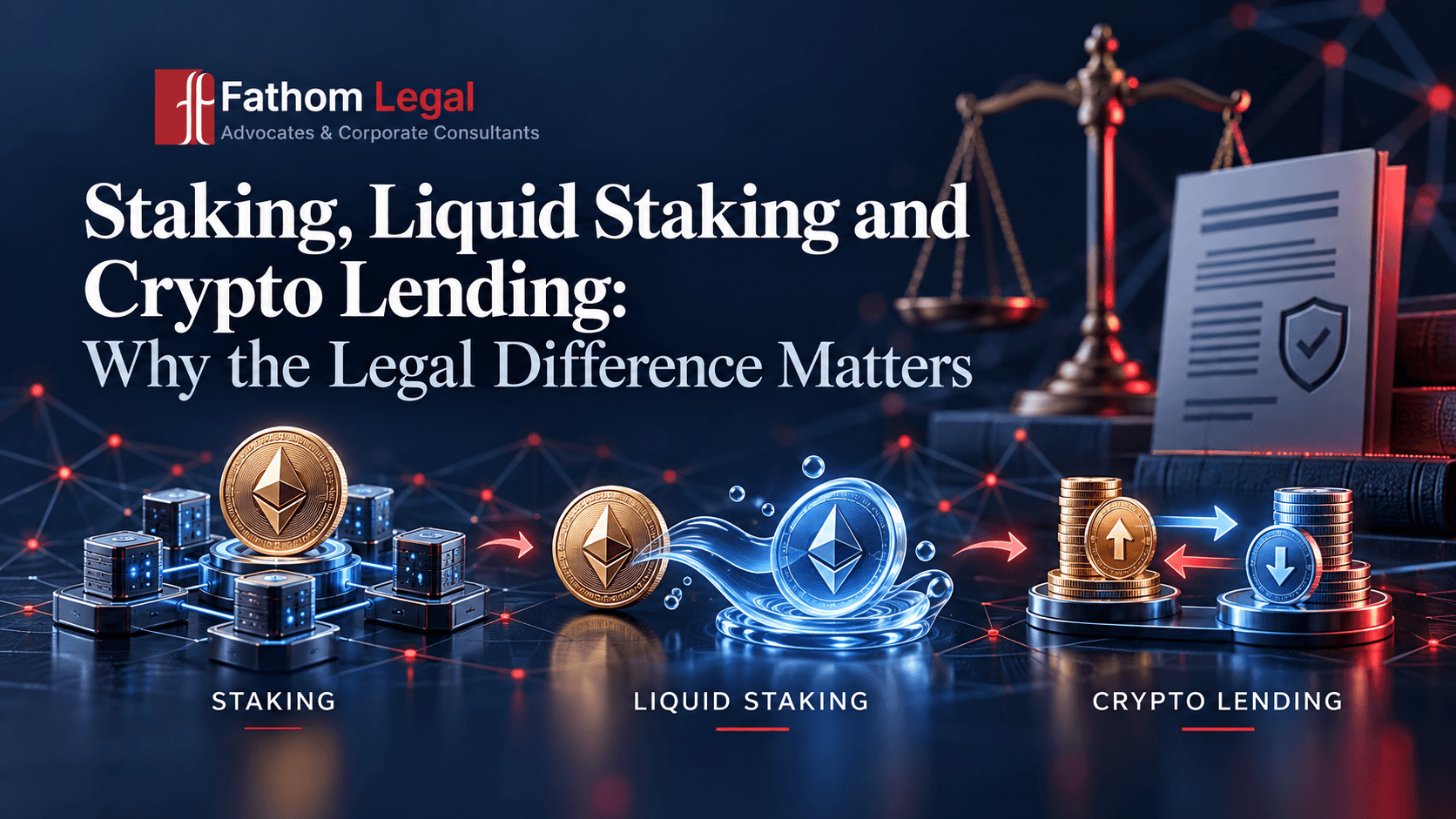
Open almost any crypto app and you will be invited to "earn" on your tokens. One screen offers 4% for staking, another 7% for lending, a third promises "rewards" on a token you have never heard of. It is tempting to see these as variations on the same idea: park your crypto, collect a return. They are not. Behind the similar marketing sit three quite different arrangements. With staking, your tokens help keep a blockchain running and the network pays you for it. With liquid staking, you do the same thing but receive a second token that stands in for your staked position. With lending, you hand your tokens to someone else, who pays interest for the privilege and promises to give them back.
That difference decides who owns the tokens, who can use them, where your return actually comes from, who absorbs the losses and what you can recover if things go wrong. For the businesses offering these products, it also decides which laws apply to them. The name on the product matters much less than what happens to the assets once you click "confirm".
Why These Products Exist
Blockchains like Ethereum, Solana and Cardano run on a system called proof of stake. Instead of relying on energy-hungry mining, they rely on participants known as validators, who lock up tokens as a kind of security deposit and, in return, check and confirm transactions. Behave honestly and the network rewards you. Cheat or fall asleep on the job and it takes a bite out of your deposit.
The catch is that staked tokens are often tied up, sometimes for days or weeks after you ask for them back. Liquid staking grew out of that frustration. It gives you a token representing your staked position, which you can trade or put to work elsewhere while the original tokens stay locked.
Lending exists for a different reason altogether. Some people want to borrow crypto, or borrow against it, without selling what they hold. They might be trading, hedging or simply need liquidity. Lenders fill that gap and are paid interest for doing so.
So all three can produce a return, but each return comes from a different place and carries a different kind of risk.
Staking
How it works
A validator who does the job properly earns rewards from the protocol itself, usually a mix of newly created tokens and a share of transaction fees. A validator who double-signs blocks, goes offline for long stretches or otherwise breaks the rules can be "slashed", meaning part of the stake is simply destroyed.
Few ordinary holders run a validator of their own. Most either delegate their tokens to an existing validator or let an exchange or platform handle the staking for them.
The legal questions
The real question is whether the provider is merely helping you take part in the network or whether it has taken control of your tokens and is promising you a return. In non-custodial staking, you keep your tokens in your own wallet and lend out only the right to validate with them. The provider never touches the assets. Custodial staking is a different animal. Your tokens move into wallets the platform controls, often sit in a common pool with everyone else's, and may, depending on the fine print, be used however the platform sees fit.
If you are using a custodial service, the terms should tell you plainly who owns the tokens while they are staked, whether the platform can lend or pledge them, how rewards and fees are worked out, who pays if a validator is slashed, and how long it takes to get your tokens back. If the terms are vague on any of these, that vagueness is itself a warning.
Pay close attention to where the return comes from. A reward that rises and falls with what the network actually pays is genuinely a staking reward. A fixed rate paid out of the platform's own pocket, whatever the network does, begins to look much more like interest on a deposit or a return on an investment, regardless of what the product is called.
Liquid Staking
A token that stands in for your stake
Imagine you stake 10 units of Token A through a liquid-staking protocol and receive 10 units of Token B in return. Token B is, in effect, your ticket: it represents your share of the staked Token A and the rewards building up on it.
Protocols handle those rewards in one of two ways. Some increase the number of Token B in your wallet over time, which is known as rebasing. Others keep your balance the same but let each Token B be exchanged for a little more Token A as time goes on. Either way, you are free to sell Token B, send it to someone else or use it as collateral in another decentralised finance (DeFi) application while your original tokens stay staked.
Why the law finds it harder
Liquid staking leaves you holding two things at once: an interest in the staked tokens and the receipt token issued against them. Your legal rights in each may be quite different.
That receipt token could be a contractual right to redeem the underlying tokens, a share in a pool of staked assets, a claim against whoever runs the protocol, or nothing more than a crypto asset that the market expects, but does not guarantee, to track the value of your stake. Calling it a "receipt" does not make it one in the legal sense, and it certainly does not guarantee you will be able to cash it in.
There is a further layer of risk that the industry calls composability. Because receipt tokens can be moved around freely, users often deposit them into lending protocols, which may lend them onward or issue yet another token against them. So-called restaking goes further still, reusing the same staked assets to secure additional services and piling new slashing conditions on top. Each step adds leverage and ties more protocols together, which means a single failure can ripple through an entire chain of positions.
Crypto Lending
A debtor and a creditor
Lending is the easiest of the three to explain and, in some ways, the most misunderstood. You transfer tokens to a borrower for a period of time, and the borrower agrees to return the same quantity, usually with interest. Notice the wording: the same quantity, not the same tokens. Once your tokens are handed over, what you usually hold is a promise to be repaid, not ownership of any particular asset.
Borrowers are often asked to post collateral. In over-collateralised lending, which is common in DeFi, the collateral is worth more than the loan, and if its value falls too far it is sold automatically to protect the lender.
On a centralised platform, your tokens typically go into a pool that the company lends out to institutions or individuals as it chooses. On a decentralised protocol, smart contracts match people supplying liquidity with people who want to borrow, and interest rates move automatically with supply and demand.
It is really about credit risk
Lending has nothing to do with securing a blockchain. The interest you earn is your compensation for giving your assets to someone else and trusting that they will come back.
That makes one question more important than any other: who is actually borrowing your tokens? It could be the platform itself, a named third party, an anonymous user of a lending pool or a smart contract with no identifiable counterparty at all. Each answer carries a very different level of risk.
Be wary of words like "deposit", "savings" or "earn account". If the arrangement is legally an unsecured loan to the platform, those words can give a badly misleading sense of safety. Customers of Celsius and Voyager learned this the hard way in 2022, when both lenders collapsed and people who thought they were holding their own tokens found themselves waiting in line as unsecured creditors. Unless a regulated protection scheme clearly applies, crypto balances do not enjoy the safeguards of a bank account.
Why Classification Matters
Regulators look past the label
Regulators and courts are interested in how a product works, not what it is called. A so-called staking product in which the platform takes custody, guarantees a fixed return and uses the tokens for unrelated purposes may well be treated as lending, deposit-taking or a collective investment scheme.
The same product can also be viewed differently from one country to the next, and depending on its design and marketing it may fall under securities law, deposit-taking rules, consumer protection or virtual-asset regulation. In the United States, regulators have indicated that straightforward protocol staking, and some forms of liquid staking, generally fall outside securities law, while making clear that guaranteed returns or discretionary use of customer assets could change that. Centralised "earn" and lending programmes, meanwhile, have repeatedly drawn enforcement action.
Internationally, the Financial Action Task Force takes the same substance-first view. If a business exchanges, transfers, holds or manages virtual assets on behalf of others, anti-money-laundering obligations follow, whatever the product is called.
Insolvency is where it really bites
The difference between these arrangements is rarely felt when markets are calm. It is felt when a platform fails. Tokens held on trust or properly kept apart from the platform's own assets may find their way back to customers. Tokens handed over as a loan usually become part of the failed company's estate and are shared out among all its creditors, often at a fraction of their value.
If the terms allow the platform to use, lend or pledge your tokens, you may be left with nothing more than an unsecured claim. A balance on your dashboard is not proof that the tokens behind it are actually there.
Tax treatment is not one-size-fits-all
India taxes transfers of virtual digital assets (VDAs) at a flat 30%, plus surcharge and cess. The only deduction allowed is the cost of acquisition, losses cannot be set off against other income, and 1% tax is deducted at source on the sale consideration. These rules have carried over into the Income-tax Act, 2025, which replaced the 1961 Act from 1 April 2026, and the definition of a VDA now expressly includes crypto-assets recorded on a cryptographically secured ledger.
What the law still lacks is specific guidance for staking, liquid staking and lending, which leaves some genuinely difficult questions. Are staking rewards taxed when they accrue, when they land in your wallet or only when you sell them, and at what value? When you swap a token for a liquid-staking receipt token, or redeem it later, is that a taxable transfer? Given that crypto-to-crypto swaps are generally treated as transfers, the risk is real. And if a lender never gets its tokens back, or a validator is slashed, can that loss be recognised at all under such strict rules?
The honest answer is that it depends on exactly how the transaction flows. Users should keep careful records of every staking, swap and redemption event, especially now that transaction-level reporting has tightened. Businesses, for their part, should not assume every "reward" is taxed the same way, or that a step inside a protocol has no tax consequence simply because no rupees changed hands.
The contract is your real protection
Code can execute a transaction, but it cannot answer every legal question. Providers need terms that clearly deal with custody, ownership, reuse of assets, how rewards and fees are calculated, and what happens in the event of slashing, liquidation, oracle failures, forks, withdrawal delays, protocol upgrades, cyber attacks and insolvency.
Marketing needs the same care. A headline like "earn up to 12%" should make clear whether that figure is an estimate, a variable rate or a guarantee, and whether it comes from staking, lending, promotional token incentives or some mix of them.
The Position in India
India has no single law that licenses staking, liquid staking and crypto lending as separate products. That does not mean they sit outside the law. Several frameworks apply at once, and a business has to work through each of them.
Tax is the most visible. Beyond the 30% levy and 1% TDS, exchanges and platforms face expanded reporting duties from 1 April 2026, aligned with the OECD's Crypto-Asset Reporting Framework. Anti-money-laundering law is the other pillar. Since March 2023, businesses that exchange, transfer, safeguard or administer VDAs, or provide related financial services, have been reporting entities under the Prevention of Money-laundering Act, 2002. They must register with the Financial Intelligence Unit (FIU-IND) and follow its AML and counter-terrorist-financing guidelines, most recently updated in January 2026. Offshore platforms that serve Indian users without registering have faced blocking orders and fines.
Beyond that, a product that looks like a collective investment scheme, a security or deposit-taking may draw in SEBI or the RBI. Consumer protection law, including the rules on misleading advertising, contract law, the Digital Personal Data Protection Act, 2023 and foreign exchange controls on cross-border flows may all apply as well.
There have been signals that more specific guidance on staking and DeFi may be on the way, but nothing is in force at the time of writing. Because the rules change through notifications and amendments, it is always worth checking the current position against official sources.
The absence of a dedicated regime should not be mistaken for a green light. If anything, it makes it more important to understand exactly what a product does.
Conclusion
Staking, liquid staking and crypto lending share a sales pitch, not a legal structure. Treating them as interchangeable is how users end up surprised and how platforms end up in trouble.
For platforms, correct classification supports better contracts, disclosures and compliance. For users, it reveals something equally important: whether the promised “yield” is a network reward, a tokenised claim or compensation for lending assets to someone who may not be able to return them.
Fathom Legal advises blockchain and digital-asset businesses on the legal structuring of staking, liquid-staking and crypto-lending products. We assist with product-classification analysis, platform terms, risk disclosures, custody and ownership arrangements, AML compliance and contractual allocation of protocol, counterparty and insolvency risks. Our focus is to help businesses build commercially workable products while preparing for India’s evolving regulatory environment.