
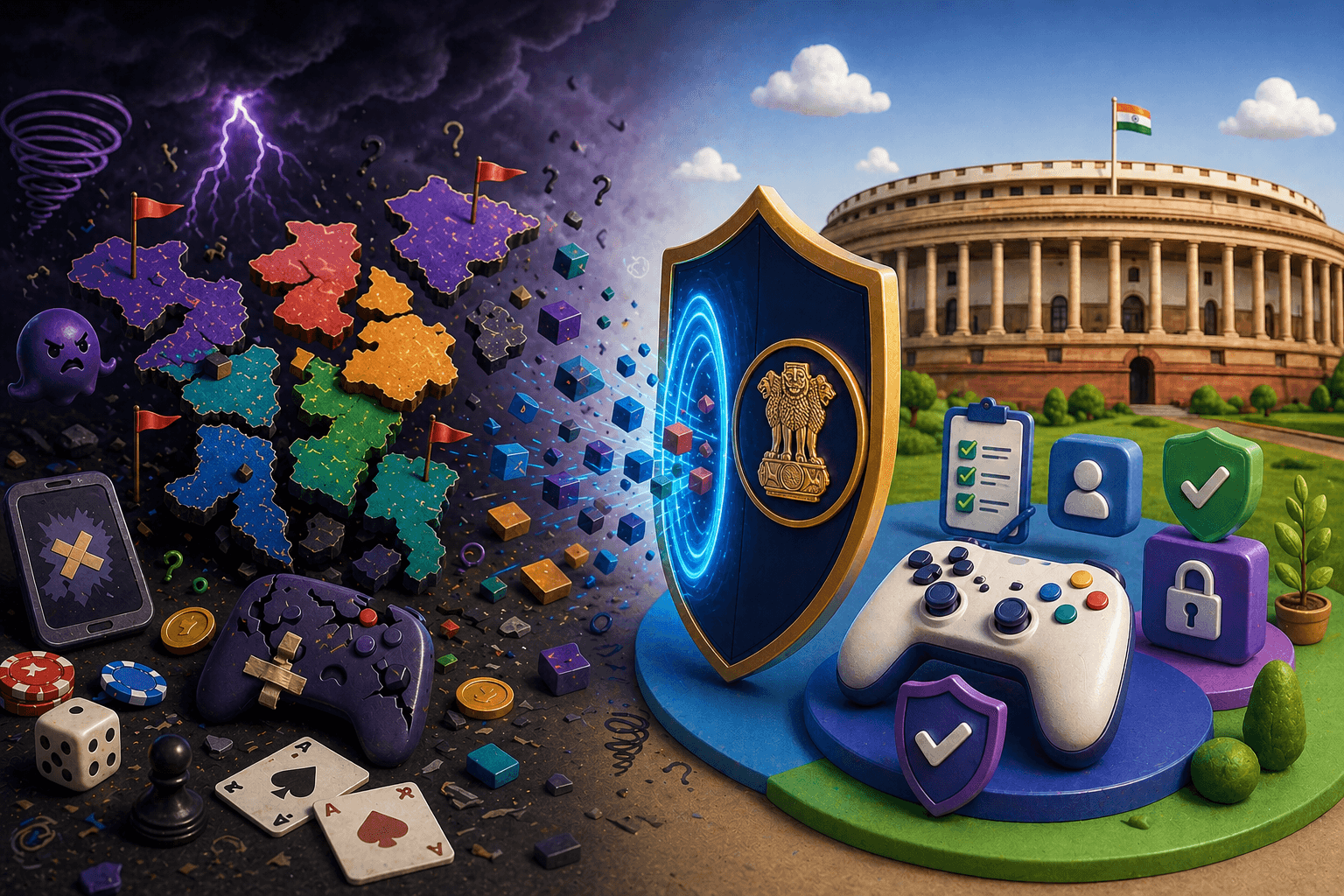
For a considerable period, India’s online gaming industry operated in a space that was commercially significant but legally unsettled. The governing framework was shaped less by statute and more by judicial interpretation, particularly the distinction between games of skill and games of chance. State legislations, often drafted with traditional gambling in mind, were applied to digital formats with varying outcomes. The result was a regulatory landscape that was inconsistent, reactive, and heavily dependent on litigation.The Online Gaming Rules, 2026 represent a shift in how the State engages with this sector. What was previously governed through a combination of judicial tests and fragmented state-level controls is now being drawn into a more centralised and structured regulatory framework.
The Legal Basis and Its Limits
The Rules have been introduced under the Information Technology Act, 2000, a statute that has increasingly been used as a vehicle for regulating digital activity. Over time, the IT Act has expanded beyond its original scope to address intermediary liability, content regulation, and platform governance.Its extension into online gaming is therefore not unexpected. It is, however, not without its limits.Online gaming raises questions that extend beyond digital intermediation. It involves elements of financial participation, behavioural risk, and in some cases, wagering. Regulating such a sector through a framework designed primarily for information flow and platform responsibility may create areas where interpretation is required to bridge conceptual gaps.This is likely to become more visible as the Rules are implemented.
From Judicial Interpretation to Regulatory Classification
Historically, the legal permissibility of gaming activities in India turned on judicially developed principles distinguishing games of skill from games of chance. Courts assessed the dominant element of the game and, based on that determination, classified the activity as permissible or otherwise.While this approach provided a degree of doctrinal clarity, it was inherently case-specific. It required litigation, interpretation, and often, time.The Rules introduce a different approach.Classification is no longer left entirely to courts. The framework now contemplates a system where games are categorised based on regulatory assessment. This includes distinctions between categories of games that may be permitted, regulated, or restricted.Where classification is judicial, it is anchored in precedent. Where it is regulatory, it is subject to administrative determination. The latter introduces flexibility, but also discretion. The boundaries of permissible activity may now depend as much on regulatory interpretation as on established legal principles.
Centralisation and the Question of Control
A key feature of the Rules is the move towards centralised oversight. The framework envisages a mechanism through which the sector is supervised at a national level, with the authority to determine classifications, prescribe standards, and take enforcement action.This marks a departure from the earlier position where regulation was largely dispersed across states and adjudicated through courts.Centralisation offers certain advantages. It can reduce inconsistencies, create uniform standards, and provide a single point of reference for compliance.Decision-making authority is concentrated within a regulatory framework that has the ability to define categories, interpret risk, and influence market access. For industry participants, this means that engagement with the regulator becomes an ongoing aspect of operations, rather than an occasional interaction triggered by dispute.
Compliance as an Operational Requirement
The Rules do not approach regulation as a licensing exercise alone. They embed compliance within the operational structure of gaming platforms.Platforms are expected to implement systems for user verification, establish internal mechanisms for grievance redressal, and ensure that their offerings align with the classifications determined under the framework. These are not peripheral requirements. They go to the manner in which the platform functions.
The involvement of financial intermediaries further extends the reach of the framework. Payment systems are expected to align with regulatory determinations, effectively creating an additional layer of oversight. Transactions linked to non-compliant activities may be restricted at the financial level, irrespective of platform intent.This creates a multi-point enforcement structure, where compliance is assessed not only at the platform level, but also through associated systems.
Impact on Existing Business Models
For platforms that have developed under the earlier regime, the Rules introduce a degree of recalibration.Business models that rely on monetisation structures involving user stakes may need to be reassessed in light of classification-based restrictions. The absence of clear, precedent-based guidance in certain areas may create uncertainty, particularly where a platform’s offering does not fit neatly within defined categories.In addition, operational requirements such as data-related obligations and user protection mechanisms may increase compliance costs. For platforms with cross-border operations, these requirements may necessitate structural adjustments to align with domestic regulatory expectations.Investment decisions are also likely to be influenced by the evolving framework. Regulatory clarity can support investment, but only where it is accompanied by predictability. Where discretion plays a significant role, investors may seek additional safeguards.
The Broader Regulatory Context
The Rules are not an isolated development. They reflect a broader regulatory pattern in India, where digital sectors that achieve scale are progressively brought within structured oversight frameworks.This approach prioritises visibility and control. It seeks to ensure that activities with economic and social impact do not remain outside regulatory reach. Online gaming, given its scale and financial implications, was always likely to be addressed within this framework.Rather than waiting for a comprehensive standalone statute, the State has chosen to extend existing legislative tools to address the sector. This allows for speed, but also requires careful interpretation to ensure coherence.
Conclusion
The Online Gaming Rules, 2026 do not resolve all questions surrounding the sector. They change the nature of those questions.The discussion is no longer limited to whether a particular game qualifies as one of skill or chance. It now includes how that game is classified, how it is regulated, and how compliance is operationalised within the platform.For participants in the ecosystem, this introduces a different kind of engagement with the law. It is less about navigating ambiguity through interpretation, and more about aligning with a framework that is defined, but still evolving in its application.This is a more structured environment, but not necessarily a simpler one.For those building or operating in this space, a considered approach to regulatory alignment at an early stage becomes important.
If you are evaluating the impact of these Rules on your platform, investment, or business model, or require assistance in navigating the compliance framework, you may consider reaching out to FLACC for support through our website.