
Introduction:
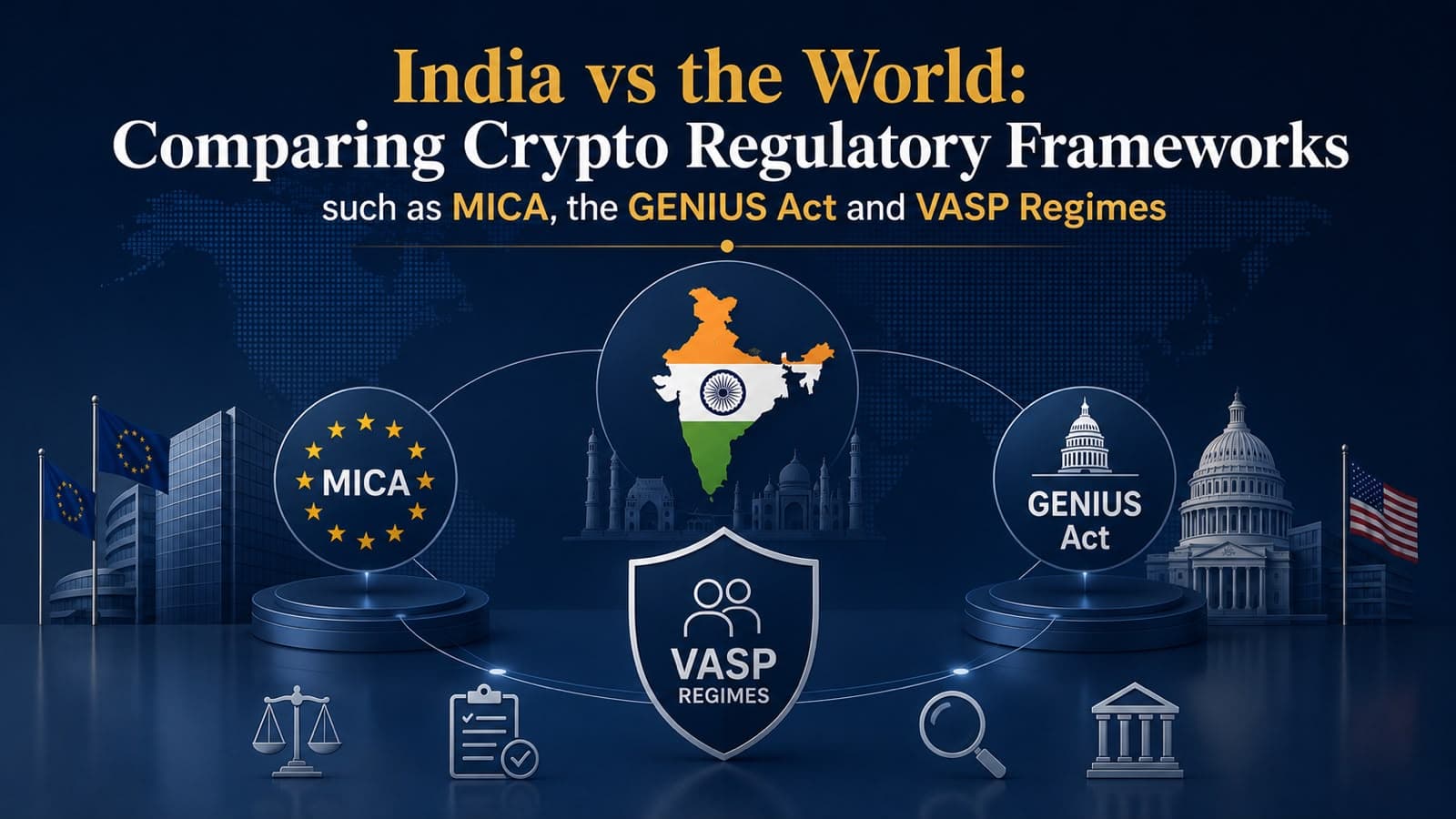
The regulation of crypto assets has evolved from a fragmented and largely reactive exercise into a sophisticated area of financial regulation. What was once viewed as an unregulated technological experiment has now become a matter of financial stability, investor protection, anti-money laundering (AML), consumer rights, prudential supervision and national security. Across jurisdictions, lawmakers have increasingly recognised that while blockchain technology and digital assets present significant opportunities for innovation, they also introduce novel legal and regulatory risks that cannot be addressed through conventional financial laws alone.The global regulatory landscape is consequently witnessing the emergence of dedicated statutory frameworks specifically designed for crypto-assets. The European Union has introduced a comprehensive, technology-neutral regulatory regime through the Markets in Crypto-Assets Regulation (MiCA), establishing a harmonised licensing and supervisory framework across all Member States. The United States, while historically relying upon fragmented federal and state regulation, has recently begun moving towards specialised legislation for payment stablecoins through the proposed GENIUS Act. Simultaneously, several jurisdictions including Singapore, the United Arab Emirates, Japan, Hong Kong, and the United Kingdom have adopted Virtual Asset Service Provider (VASP) licensing regimes aligned with the recommendations issued by the Financial Action Task Force (FATF).
India presents a markedly different regulatory narrative. Despite being among the world’s largest crypto markets by retail participation, the country has not yet enacted dedicated legislation governing virtual digital assets (“VDAs”). Instead, regulation has developed through taxation measures, anti-money laundering obligations, judicial intervention, financial intelligence reporting requirements and sector-specific circulars. Consequently, India’s framework remains compliance-oriented rather than regulatory in the traditional prudential sense.This article comparatively analyses the principal crypto regulatory models adopted globally, examining their legal architecture, supervisory mechanisms, licensing requirements, consumer protection obligations and enforcement strategies, while also evaluating India’s present position within this rapidly evolving international landscape.
Drifting towards Crypto specific regulations:
As we all can notice the global shift in today's world towards a crypto specific regulation, as earlier the regulators across jurisdictions attempted to regulate crypto assets by fitting them within existing legal categories such as securities, commodities, payment instruments or property. However, this approach resulted in inconsistent regulatory outcomes because crypto assets frequently exhibit characteristics that transcend traditional financial classifications.
The result has been the emergence of comprehensive licensing regimes designed specifically for crypto-asset intermediaries while simultaneously imposing disclosure obligations, governance requirements, capital adequacy standards, cybersecurity controls, operational resilience measures and AML/CFT compliance obligations. Having outlined the global regulatory shift, the following discussion undertakes a comparative examination of the principal regulatory frameworks governing crypto-assets across major jurisdictions. This comparison highlights both the common regulatory objectives and the jurisdiction-specific approaches adopted to balance innovation with investor protection and financial stability.
European Union: Markets in Crypto Assets Regulation (MiCA)
The European Union has established one of the most comprehensive crypto regulatory frameworks globally which is known as Markets in Crypto Assets (MiCA) regulations, 2023. This regulation became fully applicable from 30 December 2024 and forms part of the broader EU Digital Finance Package.Unlike earlier fragmented national approaches, MiCA creates a single harmonised legal framework applicable across all EU Member States, thereby eliminating regulatory arbitrage within the Union. The scope of MiCA applies to crypto assets that are not already regulated under existing European financial services legislation such as the Markets in Financial Instruments Directive (MiFID II). It categorises crypto-assets into three principal classes:
1. Asset-Referenced Tokens (ARTs)
2. Electronic Money Tokens (EMTs)
3. Other crypto-assets.
This classification enables differentiated regulatory treatment based upon the economic function and associated systemic risks of each asset category. Beyond the classification of crypto assets, MiCA establishes a comprehensive regulatory architecture comprising several core features designed to ensure market integrity, investor protection and financial stability. The principal features of the Regulation include the following:
One of the central features of MiCA is the regulation of Crypto-Asset Service Providers (CASPs). Entities providing services such as crypto custody, exchange, execution of orders, placement of crypto-assets, portfolio management, transfer services, advice, or reception and transmission of orders must obtain authorisation from the competent national authority.Once authorised, CASPs benefit from the “passporting” mechanism, permitting operations throughout the European Union without obtaining separate licences in each Member State. MiCA also imposes extensive disclosure obligations on issuers through mandatory crypto asset white papers, requiring transparent disclosure regarding project risks, governance, technology, token rights, conflicts of interest, and associated financial risks.The Regulation also prohibits insider dealing, unlawful disclosure of inside information and market manipulation under provisions broadly analogous to traditional securities market abuse laws. Furthermore, CASPs must maintain prudential safeguards, implement complaint-handling mechanisms, establish cybersecurity controls, segregate client assets and maintain governance arrangements proportionate to operational risk.
United States: The Guiding and Establishing National Innovation for U.S. Stablecoins Act, (GENIUS).
Unlike the European Union’s comprehensive legislative framework, the United States has historically regulated crypto-assets through multiple federal agencies, including the Securities and Exchange Commission (SEC), Commodity Futures Trading Commission (CFTC), Financial Crimes Enforcement Network (FinCEN), Office of the Comptroller of the Currency (OCC), Internal Revenue Service (IRS) and various state regulators. This fragmented regulatory structure has frequently resulted in jurisdictional disputes regarding whether particular digital assets constitute securities, commodities, or payment instruments. Recognising the increasing significance of payment stablecoins, the United States Congress has proposed the Guiding and Establishing National Innovation for U.S. Stablecoins Act (GENIUS) Act, aimed at establishing a dedicated federal framework for stablecoin issuance.
The GENIUS Act adopts a targeted regulatory approach by concentrating specifically on payment stablecoins rather than the broader crypto-asset ecosystem. In doing so, it establishes a comprehensive framework comprising several key regulatory safeguards aimed at ensuring financial stability, consumer protection and market integrity. These safeguards include mandatory one-to-one reserve backing, the maintenance of high-quality liquid reserve assets, periodic reserve attestations, prudential supervision of issuers, enforceable redemption rights for holders, enhanced disclosure and transparency obligations, and federal oversight of systemically significant issuers. Collectively, these measures seek to balance financial innovation with payment system stability by regulating payment stablecoins in a manner more closely aligned with traditional payment instruments than speculative investment products. Although the broader digital asset regulatory framework in the United States continues to evolve, the GENIUS Act represents a significant shift from an enforcement driven regulatory approach towards greater statutory certainty and regulatory clarity.
FATF and the Global Rise of VASP Regimes
Alongside domestic legislative initiatives, the Financial Action Task Force (FATF) has played a pivotal role in shaping the international regulatory framework for crypto-assets. As the global standard-setter for anti-money laundering and counter-terrorist financing (AML/CFT), the FATF has significantly influenced the manner in which jurisdictions regulate crypto-asset intermediaries. A major milestone in this regard was the 2019 amendment to Recommendation 15 and its Interpretive Note, which expressly extended the FATF's AML/CFT standards to Virtual Asset Service Providers (VASPs). Under this framework, member jurisdictions are required to regulate and supervise entities engaged in virtual asset activities by subjecting them to compliance obligations broadly equivalent to those applicable to traditional financial institutions. VASPs generally include entities involved in the exchange of virtual assets for fiat currencies or other virtual assets, the transfer, safekeeping or administration of virtual assets, custody wallet services, and participation in financial services relating to the issuance or sale of virtual assets.
To strengthen transparency and mitigate illicit financial risks, the FATF framework requires VASPs to implement comprehensive AML/CFT measures, including customer due diligence (CDD), beneficial ownership identification, record maintenance, suspicious transaction reporting, sanctions screening, and the "Travel Rule," which mandates the transmission of originator and beneficiary information in qualifying virtual asset transfers. The FATF standards have consequently served as the foundation for the development of VASP-specific licensing regimes across numerous jurisdictions. Countries such as Singapore, United Arab Emirates, Hong Kong, Japan, Switzerland, South Korea and Australia, along with several European jurisdictions, have incorporated these standards into their domestic legislation by establishing dedicated licensing and supervisory frameworks for VASPs. This widespread adoption underscores the FATF's role in promoting regulatory harmonisation and establishing a common global baseline for the governance of crypto-asset service providers.
India’s Regulatory Position:
Against the backdrop of these evolving international regulatory frameworks, India's approach to crypto-asset regulation remains fragmented and sector specific. Unlike the European Union's comprehensive regime under MiCA or the United States' targeted legislative initiatives such as the GENIUS Act, India has yet to enact a dedicated statute governing virtual digital assets (VDAs). Instead, the regulatory framework has developed incrementally through taxation measures, anti-money laundering (AML) obligations, judicial intervention, and regulatory guidance. The Finance Act, 2022 marked the first statutory recognition of crypto-assets by introducing the definition of "Virtual Digital Asset" under Section 2(47A) of the Income-tax Act, 1961. It further established a stringent taxation regime through Section 115BBH, imposing a 30% tax on income arising from the transfer of VDAs, while Section 194S introduced tax deduction at source (TDS) on VDA transactions to enhance traceability.
From an AML perspective, a significant development occurred with the notification issued on 7 March 2023 under the Prevention of Money Laundering Act, 2002 (PMLA), which designated entities engaged in specified VDA activities as reporting entities. Consequently, crypto exchanges and other service providers became subject to Know Your Customer (KYC), customer due diligence, record-keeping, beneficial ownership identification, suspicious transaction reporting and other compliance obligations administered by the Financial Intelligence Unit–India (FIU-IND). Judicially, the regulatory landscape was shaped by the Supreme Court's decision in Internet and Mobile Association of India v. Reserve Bank of India (2020), which set aside the Reserve Bank of India's banking restriction on crypto businesses for failing the test of proportionality. While the judgment restored banking access for crypto businesses, it did not determine the legal status of cryptocurrencies. Notwithstanding these developments, India continues to operate without a comprehensive licensing and supervisory framework comparable to MiCA or other international models. There are no dedicated statutory provisions governing the licensing of crypto-asset service providers, prudential capital requirements, custody standards, reserve requirements for stablecoins, disclosure obligations for token issuers, governance standards or market abuse. As a result, the current framework remains largely confined to taxation and AML compliance, leaving significant regulatory gaps and creating legal uncertainty for market participants.
Viewed in light of the comparative regulatory approaches discussed above, India's existing framework underscores the need for a more comprehensive legislative regime. As global jurisdictions increasingly adopt structured licensing systems and risk-based regulatory standards, India could draw upon these international models by introducing a dedicated licensing framework for crypto-asset service providers, prudential and governance requirements, disclosure obligations for token issuers, cybersecurity and operational resilience standards, consumer protection measures, and proportionate regulation for stablecoin issuers. At the same time, any future legislation must remain calibrated to India's domestic regulatory priorities, ensuring consistency with the Foreign Exchange Management Act, 1999, the Prevention of Money Laundering Act, 2002, the Payment and Settlement Systems Act, 2007, and the Digital Personal Data Protection Act, 2023 to establish a coherent and future-ready regulatory framework for crypto-assets.
Conclusion
The evolution of crypto regulation demonstrates a decisive transition from regulatory uncertainty towards structured legal governance. The European Union’s MiCA establishes perhaps the most comprehensive market-wide framework presently in force, while the United States is progressively developing specialised legislation beginning with stablecoins through the GENIUS Act. Parallelly, the FATF’s VASP standards have become the global benchmark for AML/CFT compliance, influencing domestic legislation across multiple jurisdictions. India, however, continues to regulate crypto-assets through a mosaic of taxation, anti-money laundering obligations, judicial oversight and executive notifications rather than through a unified statutory framework. While this approach has addressed immediate compliance concerns, it falls short of providing the regulatory certainty required for sustainable industry development. As digital assets become increasingly integrated into mainstream finance, India’s long-term regulatory success will likely depend upon enacting a comprehensive, risk-based, technology-neutral framework that balances innovation with investor protection, financial integrity and systemic stability. Aligning domestic legislation with evolving international best practices while preserving India’s unique regulatory priorities will be essential to ensuring that the country remains both a responsible regulator and a competitive participant in the global digital asset ecosystem.
As regulatory frameworks governing crypto-assets continue to evolve across jurisdictions, businesses engaged in digital asset activities must proactively assess the legal implications of their operations, whether in relation to licensing, anti-money laundering compliance, stablecoin issuance, token structuring, exchange operations, cross-border regulatory obligations, or data protection requirements. Given the increasing convergence of financial regulation, technology law and compliance standards, obtaining timely and jurisdiction-specific legal advice has become critical for mitigating regulatory risk and ensuring operational resilience. Fathom Legal Corporate & Associates advises businesses, fintech companies, virtual asset service providers, investors, and technology-driven enterprises on navigating the evolving digital asset regulatory landscape, including regulatory compliance assessments, licensing strategies, contractual documentation, policy advisory, and cross-border legal considerations. For assistance with crypto regulatory compliance, licensing requirements, or any related legal advisory, please contact us at assist@fathomlegal.com.