
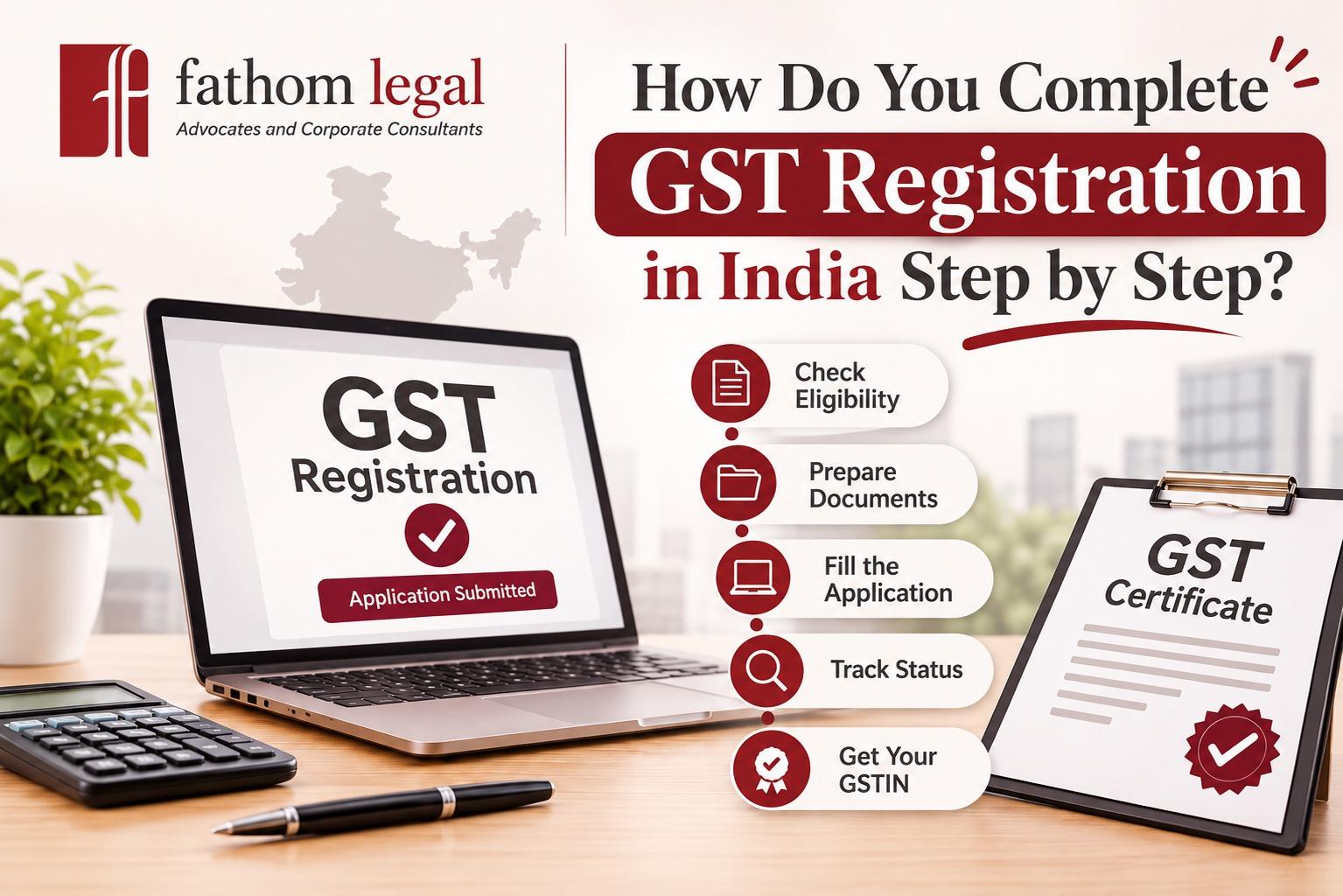
Starting a business or crossing the turnover limit raises a question almost every owner faces: how do you get a tax identity that customers, suppliers, and the government recognise? This guide explains GST registration in India in plain steps, from checking eligibility to receiving your number. Whether you run a small shop, a consulting practice, or an online store, knowing how the application works saves time and helps you avoid rejections, queries, and avoidable delays.
Who Needs to Register Under GST?
Goods and Services Tax replaced a long list of indirect taxes with a single, destination based tax. Any business that falls within its scope must be registered, and the rules depend on what you sell, where you sell it, and how much you earn. Before opening any form, it helps to confirm whether the law actually requires you to register.
Turnover Limits
The basic rule is linked to aggregate annual turnover. Businesses supplying goods are generally required to register once turnover crosses Rs 40 lakh, while service providers face a lower limit of Rs 20 lakh. For businesses in special category states, the limits are lower, commonly Rs 20 lakh for goods and Rs 10 lakh for services. These thresholds have been revised over the years, so check the current notifications or ask a professional before relying on a figure you saw online.
Cases Where Registration Is Compulsory
Some businesses must register regardless of turnover. This usually includes sellers making taxable interstate supplies of goods, people who sell through e-commerce platforms, casual taxable persons, non-resident taxable persons, and those liable to pay tax under the reverse charge mechanism. Persons required to deduct or collect tax at source also fall in this group. If your business model touches any of these situations, you should apply even if your sales are small.
Voluntary Registration
A business below the limit can still choose to register. Many small sellers do this because registration lets them claim input tax credit, work with larger buyers who insist on tax invoices, and sell across state lines with fewer restrictions. It also adds credibility when you apply for loans or tenders. The trade off is that once you register, you must file returns and follow compliance rules, even in months with little activity.
Documents to Keep Ready Before You Apply
Incomplete or unclear documents are the most common reason for queries on an application. Gather everything in scanned, legible form before you begin. The exact list changes with your business type, but most applicants need the following:
PAN card of the business or the proprietor
Aadhaar card of the proprietor, partners, or authorised signatory
Passport size photograph of the applicant or promoters
Proof of business constitution, such as a partnership deed, incorporation certificate, or LLP agreement
Proof of the principal place of business, such as an electricity bill, property tax receipt, or rent agreement with the owner's consent letter
Bank account proof, such as a cancelled cheque, passbook first page, or bank statement
Authorisation letter or board resolution for the person signing the application
Digital signature certificate for companies and LLPs
Make sure that the names, addresses, and PAN details match across all documents. Small spelling differences between a PAN and an address proof often trigger clarification requests that add days to the timeline. If you are unsure which documents apply to your business type, the team at Fathom Legal can review them before you file.
Logging In to the GST Portal and Starting Your Application
The entire application is filed online, and there is no government fee for registration. Open the official website, choose the option for new registration under the services menu, and select that you are applying as a taxpayer. You will be asked to choose your state, district, legal name, PAN, email address, and mobile number. Use contact details that you check regularly, because every OTP and notice will be sent there.
Once you have verified these details, the system generates a Temporary Reference Number. Keep it safe, since you will need it to return to the draft application if you leave halfway. On the GST portal, drafts stay available for a limited period, so there is no need to finish everything in one sitting.
Part A: Basic Details and Verification
Part A collects the identity information of the business. After you enter your PAN, mobile number, and email, two separate OTPs verify that the contact details are yours. A successful check unlocks Part B and gives you the reference number to continue. This step is short, but wrong entries here are hard to change later, so read each field carefully before submitting.
Part B: Business Details and Uploads
Part B is the longer section and is filled in using the Temporary Reference Number. It asks for trade name, business constitution, date of commencement, reasons for registration, details of promoters or partners, authorised signatory, principal place of business, additional places, goods and services you deal in, and bank details. You then upload the documents you collected earlier, with each file meeting the size and format limits shown on the screen. Choose your goods or services codes carefully, because they decide what appears in your records.
The Complete GST Registration Process in Simple Steps
After the form is filled, the next stage is verification and submission. Understanding this stage clarifies what happens behind the screen and why a few applications move faster than others.
Step 1: Complete Aadhaar Authentication
Promoters and the authorised signatory are usually asked to authenticate their Aadhaar. A link or OTP is sent to the number linked with Aadhaar, and completing it speeds up processing. Applications with authentication done are often approved faster than those that go through physical verification.
Step 2: Sign and Submit
Submit the form with a digital signature if you are a company or LLP, or use an EVC or e-signature for other categories. On successful submission, the system issues an Application Reference Number, known as ARN. Save the acknowledgment, because it lets you track the status at any time.
Step 3: Officer Review and Queries
A tax officer reviews the application, usually within a week. If more details are needed, you receive a notice asking for clarification, and you must reply with the requested information within the stated time. A clear, document backed reply helps avoid rejection. In some cases, especially those flagged for risk, the department may also carry out a physical inspection or ask for geo-tagging of the business premises.
Step 4: Approval or Rejection
If the officer is satisfied, the application is approved and a registration number, called GSTIN, is issued. If not, a rejection order is passed with reasons. A rejected applicant can correct the mistakes and file a fresh application, so a rejection is rarely the end of the road.
Receiving Your GST Certificate and What to Do Next
Once approved, you can download your GST certificate from the website using your ARN or login credentials. The certificate carries your 15 digit GSTIN, legal and trade names, constitution, address, and effective date of registration. It must be displayed prominently at your principal place of business, and a copy of it should be shared with vendors and customers who need your tax details.
Registration is only the start of the obligation. Plan for these early steps:
First, add your bank account details within the time allowed if you did not do it during the application. Second, set up an invoicing system that includes the mandatory GST details on every bill. Third, decide whether the composition scheme suits you, because it offers simpler filings at the cost of not claiming input credit. Fourth, mark your return due dates on a calendar so that late fees never surprise you.
Common Mistakes That Delay Approval
Most delays come from a handful of avoidable errors. Applicants frequently enter a trade name that differs from the one on supporting documents. Address proof is another trouble spot, since a rent agreement without the owner's consent letter often leads to a query. Others upload blurry scans, choose the wrong business category, or use an email address that they do not monitor and miss the officer's notice.
Another frequent mistake is ignoring the notice window. If an officer asks for clarification and you reply late, the application may be rejected even though everything else was correct. Keep a close watch on your email and mobile messages for the first two weeks after submission.
Finally, some businesses delay registration until they have crossed the limit by a wide margin. Late registration can attract penalties and tax liability for the period when you should have been registered. It is safer to apply as soon as you are close to the threshold or know that your model requires it. Advisers at Fathom Legal can help you check eligibility and timing before you apply.
Conclusion: Make GST Compliance Simple from Day One
Getting your tax identity does not need to be intimidating. Once you know whether you are required to register, collect clean documents, and follow the online steps in order, the application is manageable for most small businesses. Treat GST registration in India as the foundation of your compliance habits, not as a one time form. Accurate details, timely replies to officer notices, and regular return filing keep your business in good standing and your customers confident. If your situation involves multiple states, special categories, or complex supplies, a short consultation with a tax professional such as Fathom Legal can prevent costly corrections later.
Frequently Asked Questions
How long does GST registration take?
It typically takes about 3 to 7 working days if documents are clear and no queries arise.
Is there any fee for registration?
No, the government charges no fee for applying.
Can I register without a business address proof?
No, valid proof of your principal place of business is mandatory.
Can I apply for registration if my turnover is below the limit?
Yes, voluntary registration is allowed and lets you claim input tax credit.
What happens if my application is rejected?
You can fix the issues and submit a fresh application.